Showing posts with label poetry. Show all posts
Friday, August 30, 2013
Day 214: Long Night Moon
Cynthia Rylant has long been one of my favorite children's authors. Her work never ceases to amaze me, mostly because it always feels so personal in a way I have trouble describing. So touching. So real. I routinely look for her books when we are at our various local libraries, and was thrilled to bring this one home the other week. I had never seen this book before, but was instantly drawn to its cover illustration. As I opened it up and read the description on the jacket cover, I just knew I would love it.
Have you ever stopped to consider what might be revealed in one spot over one year by twelve unique and exquisite full moons?
My kids and I love observing the moon, especially on clear, summer nights. As the moon followed us home from New Hampshire last week, my son barraged us with questions. Why can we sometimes see the moon and sometimes we can't? Why do we sometimes see just part of the moon and other times we can see all of it? If the moon is made of rock, why does it glow? There's a lot to be learned about the magical moon, and I love the way this book encourages children to enjoy and appreciate the light of night in a new and different way.
Long Night Moon is the type of book that I love a little more each time I read it. At first glance, I was captivated by the artwork. If you've ever tried to paint or draw moonlight, you know how difficult it is. Mark Siegel's illustrations capture the feel and presence of moonlight magnificently.
A second reading found us exploring the meaning behind the names of the moons each month. As Rylant explains at the outset, "Native Americans gave names to the full moons they watched throughout the year. Each month had a moon. And each moon had its name..." While the monthly names in this story aren't all the same as others that I've researched, I love the way each one captures the essence of the season and gets us thinking about the changes in nature at the time. "In March a Sap Moon rises over melting ponds, sleepy bears, small green trees. It tells a promise and a hope... In July the Thunder Moon trembles, shudders, and disappears in a thick black sky. It listens to the clouds beat their drums." The book is more poetry than story, but combined with Siegel's artwork, it tells a beautiful story. Its pace is calming and slow, making it especially lovely to read at bedtime, but it's well worth a read at any time of day.
Be sure to read the note from the illustrator at the end of the book, too. In it, Siegel describes how he took many long, moonlit walks to help inspire his art and find the perfect medium for this book. "In my busy, crowded life, I'd never given so much attention to moonlight: What is it like? How does it feel? What makes it so special?" He also explains how Rylant "captured not just one, but many moods of night" throughout the book, and that these "distinct atmospheres seemed best explored in one continuous 360-degree panorama over the course of a year." This artistic technique can only really be noticed if you slow down and pause before turning the page, allowing time to soak in the whole scene before moving on. Reading this background made the book all the more impressive for me. I'll include my favorite part below, for it paints a far better picture of the wonder of this story than I ever could.
"I realize now how tempting it is to think that nature closes up shop after sunset, but this isn't so. When the sun goes down, nature doesn't disappear. She shows us another face, one that is just as complex and astonishing as the face she wears during the day. When we are young children, night sometimes has a forbidding, or even forbidden quality -- it is, after all, time for bed. But its attraction is no less powerful. May the words and images of Long Night Moon offer a safe invitation to savor the night and celebrate its otherwise hidden wonders." ~M.S.
Tuesday, August 6, 2013
Day 213: Where Fish Go in Winter
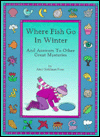
A few years ago, my mom gave me a big bin of books that she had saved from my (and my brothers') childhood. Some of them were classics that we already knew and loved, but others, like this gem here, we had never read or heard of before. The very first time I read this book, I knew I had to feature it on this blog. My son fell in love with it the first time we read it, too, and it's truly a wonderful book. It was first published over 25 years ago in 1987, so the hardcover copy that I have seems rather hard to find now.
Fortunately, however, an easy reader paperback version was published in 2002 -- that's the one shown at the very beginning of this post -- which, as far as I can tell, has the same text as the original but with different illustrations. Plus, it's only $3.99! Can't beat that!
If you can ever get your hands on a copy of this book either at the library or your local bookstore, please do. It's a fabulous collection of questions and answers that inquiring minds everywhere will love. I smiled as I read through the questions that are the topics of each page, all of which are the very types of questions my curious, nature-loving son loves to ask (often at the most surprising of times.) Where do fish go in winter? How do birds fly? Why do leaves change colors? What is the sound in a seashell? How do seeds know which was is up? How do cats purr? How does popcorn pop? Why do snakes shed their skin? Do islands float?
The answers are given in rolling, rhyming reply in a way that explains why scientifically, yet simply. I definitely learned a few things reading this book, too, which I always love. Did you know that not all of the strands in a spider's web are sticky, or that the noise we hear when we hold a shell up to our ear is caused not only by the sound of blood rushing through our ear, but also by both air molecules bouncing around? I'll share an example so you can get a taste of just how informative and lovely this book really is.
What do clouds feel like?
Would clouds feel fluffy,
Soft and grand,
If I could touch them
With my hand?
To clutch a cloud
Inside your fist
Would be like holding
Morning mist.
Clouds are not
The way they seem.
They weigh no more
Than fog or steam.
They're made of tiny
Water drops,
So light they float
Above rooftops.
I'd say this book is best suited for preschoolers and elementary students, but would make a fabulous addition to any child's library. It's a must for any classroom, too. As I mentioned earlier, the easy reader version (Level 3) seems easier to come by, but there are a bunch of the original hardcover versions available used on Amazon starting at only $0.01 (plus shipping.) However you track down a copy of this book, I hope you love it as much as we do.
Easy reader paperback: Hardcover (original version):
Monday, October 1, 2012
Day 172: A Leaf Can Be...
We've reached that magical week in New England where, all of a sudden, I look around and realize that the leaves are turning vibrant shades of yellow, orange, and red. I love summer as much as anyone, but fall is my favorite season. It is the reason why I can't imagine living anywhere other than New England: the crunch of leaves underfoot, cool days and even cooler nights, the crisp smell of the air, the crackle of the first fire in our fireplace. I love experiencing four distinct seasons and seeing the natural world transform in all its wonder all around us... even when it means my husband and I spend hours raking thousands of oak leaves from our lawn. Our kids are always more than happy to "help" us with this, jumping in and racing through the piles of leaves in a state of pure childhood bliss. I raked our first official leaf pile today (solely for my son's jumping entertainment), and realized that it would be a perfect day to feature this wonderful book!
My children love nature, so when I saw this book on the "Staff Recommendation" shelf at the library a few weeks ago, I knew I had to bring it home. Thank you, Fran the librarian, for introducing us to this beautiful story! In A Leaf Can Be, author Laura Purdie Solas takes us on a "poetic exploration of leaves throughout the year," from the gently unfurling new leaves of spring, to the frost tipped leaves of winter. In her lovely, lyrical way, Solas reminds us that leaves can be all kinds of things depending on the time and place: "Sun taker. Food maker... Air cleaner. Earth greener... Wind rider. Lake glider..." And of course my son's favorite: "Pile grower. Hill glow-er." The verses are simple but perfect, and Violeta Dabija's illustrations are gorgeous! Her use of color and light magically brings the pages to life, and I always find myself stopping and staring at the pictures longer than usual before I turn to the next page. We also love the additional information featured at the back of the book, which explains in more detail how leaves serve their many purposes highlighted throughout the story. A Leaf Can Be... is a perfect book to share as part of a preschool or elementary nature unit, or simply to snuggle up and enjoy with your child at any time of year.
Tuesday, August 2, 2011
Day 89: If Not for the Cat
I love, love, love haiku poetry. Love it. I can still remember writing and illustrating my own book of haiku when I was in third grade and dedicating it to one of the cool, young teachers in my after-school program named Rhonda. As a kid, I found most poetry boring, unless it was written by Shel Silverstein. There was something about haiku, though, that really grabbed me. I think what I loved most about it was its accessibility. If you're unfamiliar with haiku, it's a form of Japanese poetry consisting of three lines with a syllabic form of five/seven/five. Seventeen syllables. That's it. As a student, knowing I only had to come up with seventeen syllables took a lot of the stress off of writing a poem. Anyone can do that, right? Sure. But what is truly wonderful about haiku is how beautifully descriptive those few words strung together can be. I teach my seventh grade students about haiku poetry during our unit on East Asia. In what is one of my favorite events of the school year, students spend a few days writing and illustrating their own books of haiku, which they then read aloud and share with their peers during a class tea party. I even invite their parents to come. We drink tea, have snacks, and share poetry with one another. It's wonderful. I introduce our little project by reading Jack Prelutsky's If Not for the Cat. After discussing the basics of haiku, I try to really emphasize that what makes it feel easy (it's brevity) is also what makes it so hard. Whatever you're trying to say, whatever image you're trying to paint in your reader's mind, you've only got seventeen syllables in which to do it. Word choice is everything. When we read If Not for the Cat, I ask the students to close their eyes and listen carefully to what I am reading. At the end of each haiku, they are to say outloud what type of animal they think the poem is about. Once they guess, I turn the book around and show them the pictures. Try it now and see if you can guess, too:
If not for the cat
And the scarcity of cheese,
I could be content.
(Mouse)
We are wrinkled hulks
With astonishing noses,
Our ears block the sun.
(Elephants)
Boneless, translucent,
We undulate, undulate;
Gelatinously.
(Jellyfish)
Don't you wish you could see the pictures now? I assure you, they are as wonderful as the poems themselves. Now, I know this isn't my typical blog post, but I guess where I'm going with this is that this is a fabulous book to introduce children of any age to haiku poetry. (I can safely say this after having successfully captured the attention of hundreds of 12 and 13 year olds in my classroom as well as my preschooler at home.) You could use it to expose your child to poetry, or Japanese culture, or in a tutorial about the power of descriptive writing. Use it to help a child's listening skills by withholding the pictures until he's ventured a guess like I do with my students. Or, just read it for fun and enjoy the wonderful poems and illustrations of various animals. Whatever your reason, find a copy at your local library and read it with your child. It's an absolutely fabulous book no matter how or why you read it.
If not for the cat
And the scarcity of cheese,
I could be content.
(Mouse)
We are wrinkled hulks
With astonishing noses,
Our ears block the sun.
(Elephants)
Boneless, translucent,
We undulate, undulate;
Gelatinously.
(Jellyfish)
Don't you wish you could see the pictures now? I assure you, they are as wonderful as the poems themselves. Now, I know this isn't my typical blog post, but I guess where I'm going with this is that this is a fabulous book to introduce children of any age to haiku poetry. (I can safely say this after having successfully captured the attention of hundreds of 12 and 13 year olds in my classroom as well as my preschooler at home.) You could use it to expose your child to poetry, or Japanese culture, or in a tutorial about the power of descriptive writing. Use it to help a child's listening skills by withholding the pictures until he's ventured a guess like I do with my students. Or, just read it for fun and enjoy the wonderful poems and illustrations of various animals. Whatever your reason, find a copy at your local library and read it with your child. It's an absolutely fabulous book no matter how or why you read it.