Story time is the best time of the day. Whether we're snuggled up on the couch or cozy in our pjs before bed, reading stories with my little ones is one of my favorite things to do. Everyone has a favorite book they remember from their childhood, and every day, parents and kids are discovering new classics of their own. There are many fabulous children's books out there, some of which everyone knows about and others we would have never discovered had my son not simply pulled a random book off a library shelf. I created this blog to share some of these wonderful stories with you. Think of it as a year's worth of the best children's books around, since no day should be without a great story. In the end, I hope we'll all have discovered at least a few new titles that will have made their way onto our list of family favorites. Enjoy!


Friday, August 30, 2013

Day 214: Long Night Moon


Cynthia Rylant has long been one of my favorite children's authors.  Her work never ceases to amaze me, mostly because it always feels so personal in a way I have trouble describing.  So touching.  So real.  I routinely look for her books when we are at our various local libraries, and was thrilled to bring this one home the other week.  I had never seen this book before, but was instantly drawn to its cover illustration.  As I opened it up and read the description on the jacket cover, I just knew I would love it.

Have you ever stopped to consider what might be revealed in one spot over one year by twelve unique and exquisite full moons?

My kids and I love observing the moon, especially on clear, summer nights.  As the moon followed us home from New Hampshire last week, my son barraged us with questions.  Why can we sometimes see the moon and sometimes we can't?  Why do we sometimes see just part of the moon and other times we can see all of it?  If the moon is made of rock, why does it glow?  There's a lot to be learned about the magical moon, and I love the way this book encourages children to enjoy and appreciate the light of night in a new and different way.

Long Night Moon is the type of book that I love a little more each time I read it.  At first glance, I was captivated by the artwork.  If you've ever tried to paint or draw moonlight, you know how difficult it is.  Mark Siegel's illustrations capture the feel and presence of moonlight magnificently.

A second reading found us exploring the meaning behind the names of the moons each month.  As Rylant explains at the outset, "Native Americans gave names to the full moons they watched throughout the year.  Each month had a moon.  And each moon had its name..." While the monthly names in this story aren't all the same as others that I've researched, I love the way each one captures the essence of the season and gets us thinking about the changes in nature at the time.  "In March a Sap Moon rises over melting ponds, sleepy bears, small green trees.  It tells a promise and a hope... In July the Thunder Moon trembles, shudders, and disappears in a thick black sky.  It listens to the clouds beat their drums."  The book is more poetry than story, but combined with Siegel's artwork, it tells a beautiful story.  Its pace is calming and slow, making it especially lovely to read at bedtime, but it's well worth a read at any time of day.

Be sure to read the note from the illustrator at the end of the book, too.  In it, Siegel describes how he took many long, moonlit walks to help inspire his art and find the perfect medium for this book. "In my busy, crowded life, I'd never given so much attention to moonlight:  What is it like?  How does it feel? What makes it so special?"  He also explains how Rylant "captured not just one, but many moods of night" throughout the book, and that these "distinct atmospheres seemed best explored in one continuous 360-degree panorama over the course of a year."  This artistic technique can only really be noticed if you slow down and pause before turning the page, allowing time to soak in the whole scene before moving on.  Reading this background made the book all the more impressive for me.  I'll include my favorite part below, for it paints a far better picture of the wonder of this story than I ever could.

"I realize now how tempting it is to think that nature closes up shop after sunset, but this isn't so.  When the sun goes down, nature doesn't disappear.  She shows us another face, one that is just as complex and astonishing as the face she wears during the day.  When we are young children, night sometimes has a forbidding, or even forbidden quality -- it is, after all, time for bed.  But its attraction is no less powerful.  May the words and images of Long Night Moon offer a safe invitation to savor the night and celebrate its otherwise hidden wonders." ~M.S.


Tuesday, August 6, 2013

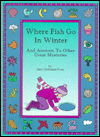
Day 213: Where Fish Go in Winter

A few years ago, my mom gave me a big bin of books that she had saved from my (and my brothers') childhood.  Some of them were classics that we already knew and loved, but others, like this gem here, we had never read or heard of before.  The very first time I read this book, I knew I had to feature it on this blog.  My son fell in love with it the first time we read it, too, and it's truly a wonderful book.  It was first published over 25 years ago in 1987, so the hardcover copy that I have seems rather hard to find now.  
Fortunately, however, an easy reader paperback version was published in 2002 -- that's the one shown at the very beginning of this post -- which, as far as I can tell, has the same text as the original but with different illustrations.  Plus, it's only $3.99!  Can't beat that!

If you can ever get your hands on a copy of this book either at the library or your local bookstore, please do.  It's a fabulous collection of questions and answers that inquiring minds everywhere will love.  I smiled as I read through the questions that are the topics of each page, all of which are the very types of questions my curious, nature-loving son loves to ask (often at the most surprising of times.)  Where do fish go in winter?  How do birds fly?  Why do leaves change colors?  What is the sound in a seashell?  How do seeds know which was is up?  How do cats purr?  How does popcorn pop?  Why do snakes shed their skin?  Do islands float?

The answers are given in rolling, rhyming reply in a way that explains why scientifically, yet simply.  I definitely learned a few things reading this book, too, which I always love.  Did you know that not all of the strands in a spider's web are sticky, or that the noise we hear when we hold a shell up to our ear is caused not only by the sound of blood rushing through our ear, but also by both air molecules bouncing around?  I'll share an example so you can get a taste of just how informative and lovely this book really is.

What do clouds feel like?
Would clouds feel fluffy, 
Soft and grand,
If I could touch them
With my hand?

To clutch a cloud
Inside your fist
Would be like holding
Morning mist.

Clouds are not
The way they seem.
They weigh no more
Than fog or steam.

They're made of tiny
Water drops,
So light they float
Above rooftops.

I'd say this book is best suited for preschoolers and elementary students, but would make a fabulous addition to any child's library.  It's a must for any classroom, too.  As I mentioned earlier, the easy reader version (Level 3) seems easier to come by, but there are a bunch of the original hardcover versions available used on Amazon starting at only $0.01 (plus shipping.)  However you track down a copy of this book, I hope you love it as much as we do.

Easy reader paperback:     Hardcover (original version):
       

Wednesday, July 31, 2013

Day 212: Penguin on Vacation

My daughter received this adorable book recently when we were on vacation with the ever-generous Uncle Jeff, and both she and my son have loved it ever since.  I found my son reading it on his bed many times throughout the week, and I loved listening in when he'd read it to my daughter as they snuggled up next to each other.  We all read it each night at bedtime, too -- usually twice.

The story is simple but sweet, with charming, colorful illustrations to match.  After growing tired of his cold climate living, Penguin decides to set off for warmer shores.  When he finally arrives on a tropical island, though, he's not so sure what to make of the place.  He can't do any of his usual vacation activities such as skiing, skating, or sledding, and starts feeling a bit lost and lonely.  Fortunately for Penguin, he is befriended by a fun-loving crab, who shows him that the best part about vacation isn't always what you do, but who you spend it with.

The first time I read this book, I thought it was cute and sweet.  The more I read it, though, the more I really came to love it.  As so often happens, this was partly because I saw how much my children love this book.  It was a gift for my daughter (who just turned 3), and given that my son has been really into reading the Magic Treehouse Series lately, I worried that perhaps it wouldn't hold his interest as much because it is shorter than most of the books he's been reading.  It only took one read through for me to realize that I needn't worry.  He's not too old to love this book at all; in fact, he might even love it more than his sister.

I had never read anything by Salina Yoon before this book, so I'm eager to check out some of her other work the next time we're at the library.  I've heard that another book in the series, Penguin and Pinecone, is quite endearing, too.  (And with a silly title about a pinecone, my kids can't wait to get their hands on it.)  If you're looking for a good pre-beach vacation story or just an all-around sweet book about friendship, Penguin On Vacation is a must for your book list.

Oh, and if you do go looking for it the next time you're at the library, you might need to check the new arrivals shelf as it just came out a few months ago (April 2013.)  Enjoy!

Friday, July 26, 2013

Day 211: Cloudy With a Chance of Meatballs

Cloudy With a Chance of Meatballs is one of those childhood classics that somehow has not yet made it into our home library (or on to this blog) until now.  I brought it home from the library once when my son was 2 or 3, but at the time, it was too long to sufficiently hold his interest.  Not anymore!  My mom recently gave us the copy that had been my brothers' when they were little, and my son (now 5) has requested it at bedtime every night for almost a week now.

If you are unfamiliar with this fantastical story, it's about the unique, faraway town of Chewandswallow.  It's a town like any other, for the most part, with lovely stores along its main street, houses with gardens and trees, a school.  "The only thing that was really different about Chewandswallow was its weather.  It came three times a day, at breakfast, lunch, and dinner.  Everything that everyone ate came from the sky."  Imagine a world where you could wake up one morning and, "after a brief shower of orange juice, low clouds of sunny-side up eggs moved in, followed by pieces of toast.  Butter and jelly sprinkled down for the toast.  And most of the time it rained milk afterwards."  Hot dogs blown in from the northwest, mustard clouds, Jell-O sunsets.  Wouldn't that just be amazing?

Life went along happily in Chewandswallow, until one day, the weather took a turn for the worse.  A giant pancake fell on the school and couldn't be removed, and the maple syrup that rained down nearly flooded the town.  Other days saw only gorgonzola cheese, or overcooked broccoli, or pea soup fog so thick that no one could see anything.  Eventually, things got so bad that everyone had to abandon Chewandswallow and leave it behind forever.

It's a story that is as delightful as it is clever, with illustrations that are bound to captivate you read after read after read.  I personally find the coloring of the illustrations a little strange (maybe it's just our version), but the detail of the drawings is simply fantastic and we find something new and creative every time we read it.  One of my favorite pictures is that of the boat made of stale bread and peanut butter, with pizza and swiss cheese for sails and a bacon flag.  Ralph's Roofless Restaurant is pretty clever, too.

Perhaps my favorite thing about this story, though, is that it is presented in the form of a bedtime story told by a grandfather to his grandchildren at bedtime; or rather, a child's recollection of a story her grandfather told her at bedtime.  My favorite lines in the whole book are "Henry and I were awake until the very end of Grandpa's story.  I remember his goodnight kiss." This line always reminds me of the incredible significance of simple moments like these.  Moments that, in and of themselves, might not seem like anything particularly noteworthy or unique, but that can linger in our children's memories long after we've forgotten them.  Moments that I remind myself to take time to savor and appreciate while they are happening.  It reminds me of one of my favorite quotes:  "Enjoy the little things in life, for one day you may look back and realize they were the big things."  I guess we should never underestimate the wonderful power of stories and goodnight kisses.

Wednesday, July 17, 2013

Day 210: Actual Size

We're on a bit of a Steve Jenkins kick here in our house lately, so I thought I'd feature another one of his books that also happens to be my son's current favorite:  Actual Size.  We first came across Jenkins' work with Hottest, Coldest, Highest, Deepest, and later discovered Living Color, both of which we all loved.  After renewing Living Color from the library 4 times, we finally returned it and brought home Actual Size, instead.  In this fun, informational book, Steve Jenkins uses his impressive paper collage art to show animal features in their real size:  the 2-inch-long pygmy shrew, the 12-inch-wide eye of a giant squid, and the 4-inch long tooth of a great white shark, to name a few.  My son particularly loves the 12-inch wide Goliath birdeater tarantula and 2-foot long giant anteater tongue.  (I love the fold-out picture of the saltwater crocodile's head and the African elephant's foot, myself.)  My little guy and I both love learning about animals, but what makes this book so great is that it depicts, in actual size, right there on the page, the very facts we are learning.  It's one thing for him know that an atlas moth has a 12 inch wing span, but another for him to see just how big that really is.  The back of the book contains additional information about each featured animal, as well, making this another fabulous read for any young animal lovers out there.

Oh, and if you're looking for a fun activity to do with your child after reading this book, trying having him create his own "Actual Size" book.  After reading this a few times, my son excitedly said, "Hey!  I have an idea!  Let's make an "Actual Size" book about dragons!"  And he got right to work.  He's invented many species of dragons in the past few months, so has had lots of fun drawing pictures of their claws, wings, teeth, footprints, and eyes in his art journal.  I just love it when my kids think up their own fun, creative activities!

Thursday, June 27, 2013

Day 209: Living Color


A few days ago, a follower of the blog asked me for some nonfiction suggestions for 5-8 year olds.  As I searched through some past posts to see what titles I could share, I realized that I haven't featured many nonfiction titles on here.  Making nonfiction appealing to little ones can be tricky, but there are some gems out there that my kids and I absolutely love.

Living Color is one such book.  In fact, it's the kind of book for which I knowingly and willingly pay overdue library fines, because my son loves it that much and we've already renewed it as many times as we're allowed.  (I plan on sneaking it back to the library tonight so that it will be there for him to take out again tomorrow.)  Time to add another title to our must-own list!

We found this book on the library shelf in the nonfiction section about animals, and it was love at first read for my little nature lover.  In Living Color, author and illustrator Steve Jenkins has created a fabulous book that "takes a look at color in the animal world and some of the ingenious ways it is used."  Creatures of all kinds are sorted by color within its pages -- birds, spiders, snakes, fish, lizards, mammals -- each with an informative little description about what makes this animal unique.  The end of the book features an illustrated glossary of each animal mentioned within, including more information about the creature's size, habitat, and diet.  There is also an interesting page spread about why animals are different colors, how their colors are created, and how their colors have evolved through natural selection.  It's fascinating, colorful, and full of information for curious little minds.

If your child loves animals, science, or nature, be sure to look for this book the next time you are at the library.  My daughter (almost 3) loves looking at the pictures with us and learning about the animals, though doesn't have the attention span to sit through the reading the whole thing.  My 5 1/2 year old son, however, asks me to read this to him from cover to cover on a regular basis.

I've learned that Steve Jenkins has some other fabulous nature books out there, too, so am eager to look for more of them when we go to the library tomorrow.  In fact, I just realized that he also wrote Hottest, Coldest, Highest, Deepest, another great nonfiction book that we've read and loved.  If we're lucky, perhaps we'll find ourselves coming home with more than one of his books tomorrow.  If the others are as good as these ones, we'll be sure to let you know.

Thursday, June 13, 2013

Day 208: Cookies: Bite-Size Life Lessons

Sometimes when we're at the library and I don't have my list of "books-to-find," I turn to the shelves to find particular authors whose works we've enjoyed in the past.  Other times, my searches are more random, but last week, while I quickly perused the shelves for a few new books and my kids played with the puppets and trains, I employed the former strategy.  I was in the Q-R-S section, so looked to see what other stories Amy Krouse Rosenthal might have waiting for us.  We've enjoyed Duck! Rabbit! and Bedtime for Mommy, so I thought she might be a good bet.  When I saw a book called Cookies, I immediately took it off the shelf and added it to our pile.  We love baking cookies almost as much as we love reading, so I knew my kids would be excited to read it, too.

What a gem of a story!  Cookies: Bite Size Life Lessons explains the meaning of 21 different words -- some common, some new -- by defining them in terms of scenarios to which kids can easily relate.  The idea behind this adorable story is so creative and brilliant.  I just love it!  The illustrations are lovely, too.  Here are a few of my favorite examples from the book:

Cooperate means, How about you add the chips while I stir?
Modest means you don't run around telling everyone you make 
the best cookies, even if you know it to be true.
Trustworthy means, If you ask me to hold your cookie until you come back, 
when you come back, I will still be holding your cookie.
Open-minded means, I've never seen cookies like that before, but, uh, sure, I'll try one.  
Regret means, I really wish I didn't eat so many cookies.


Sweet, isn't it?

My kids are always asking me what words mean, and sometimes I struggle to define them in a way they can easily understand.  When this happens, I've found it is better and more meaningful to use the word in context rather than giving them a more traditional definition.  Cookies does just that, only far better and more creatively than I ever could.  It's sweet, clever, and a great way to teach children about some of life's most valuable qualities.  Combine reading this story with baking cookies of your own and you've got a perfectly fun-filled afternoon!

Enjoy!